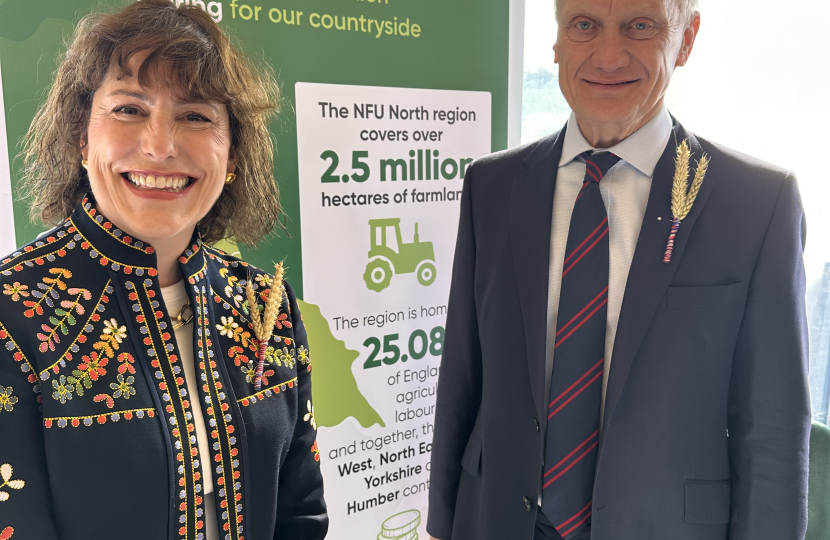
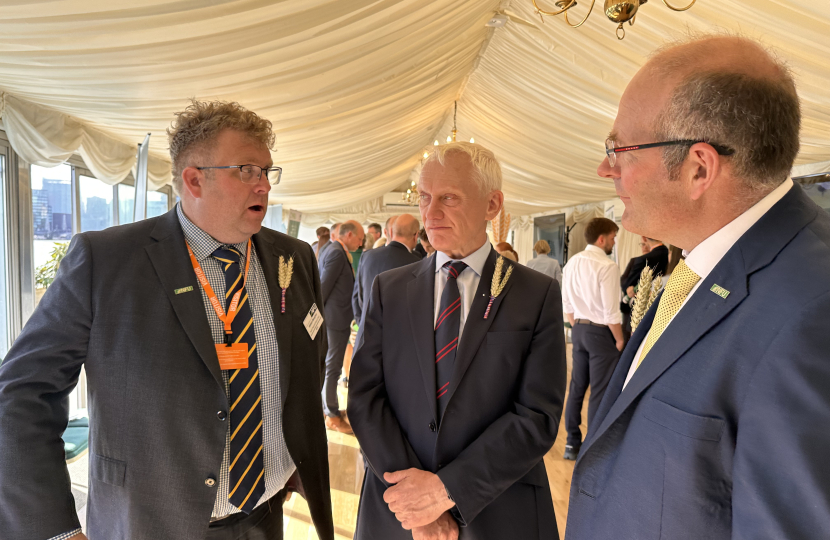
Graham has backed East Yorkshire farmers and called for Britain to put food security at the heart of national policy after hearing first-hand about the pressures facing farming.
Meeting farmers and the National Farmers’ Union in Parliament for Back British Farming Day, Graham discussed the difficult harvest, volatile prices, high input costs and the longer-term challenge of keeping British farms profitable.
The conversations echoed responses to Graham’s Rural East Yorkshire Survey, where farmers have raised concerns about poor harvests, fertiliser and other input costs, taxation, regulation and the prices they receive for their produce.
One farmer summed up the uncertainty by asking simply: “Is there a future in farming?”
Another asked: “What can we do to make our farming business turn a profit next year?”
Graham heard that November wheat has risen to around £215 a tonne following a recent increase, while oilseed rape is around £450 a tonne.
But a higher crop price does not necessarily mean a profitable harvest.
Farmers are also dealing with Nitram fertiliser at around £350 to £360 a tonne and red diesel at around £1.08 a litre, while difficult growing conditions have left some East Yorkshire farms reporting substantially lower yields.
For farmers, the margin matters. A higher wheat price is little comfort if there is less wheat to sell and it has cost considerably more to grow it.
Graham believes farmers need the confidence to invest in machinery, buildings, reservoirs and other improvements which make their businesses more productive and resilient.
He is backing Conservative plans to scrap Labour’s changes to Agricultural Property Relief and Business Property Relief, which the Conservatives have called the Family Farm Tax, so viable family farms can continue to be passed from one generation to the next.
He also wants to keep down the cost of essential inputs such as fertiliser, and backs Conservative plans to scrap the UK Carbon Border Adjustment Mechanism, which the party argues would increase costs for British farmers.
Graham believes these individual pressures point to a bigger question: how much of its own food does Britain need to be able to produce to remain secure?
He is calling for the Government to establish an evidence-based national food-security benchmark, regularly reviewed, so ministers understand the minimum level of domestic food production Britain needs and consider food security when making decisions which affect farming.
Graham believes this can be done while maintaining competitive markets and giving farmers the confidence that Britain intends to retain the capacity to produce its own food.
The need for resilience was also highlighted by discussions about animal disease, supply chains and Britain’s reliance on imports.
Graham spoke to NFU livestock representatives about the spread of bluetongue and the importance of farmers speaking to their vets about vaccination. He also heard concerns about delays in vaccine supply and the need to ensure sufficient supplies are available as the disease spreads.
He believes the same principle applies across farming: Britain cannot wait for an international crisis, disease outbreak or supply-chain disruption before asking whether it has retained enough domestic capacity to feed itself.
Graham said:
“East Yorkshire produces some of the finest food in the country, but producing food has to pay.
“I’ve been talking to farmers about wheat at around £215 a tonne, Nitram at £350 to £360 a tonne, red diesel at around £1.08 a litre and, in some places, substantially lower yields. You cannot look at the price of wheat in isolation and conclude farmers are doing well. What matters is what is left after you’ve grown it.
“That is why farmers need confidence. They need to know they can invest in their businesses, deal with volatile costs and pass a viable farm to the next generation.
“But there is a bigger issue here too. Food security is national security.
“I’m a free marketer, but nobody seriously believes Britain could safely produce just five per cent of the food we need and rely on the rest of the world for everything else. So where is the safe level? We should establish that from the evidence, review it regularly and make sure government policy does not inadvertently undermine our ability to feed ourselves.
“We have twice faced the threat of being starved out in the last 120 years. In a dangerous and uncertain world, maintaining our ability to produce food is not special pleading for farmers. It is basic national resilience.
“I want Britain to grow more of its own food, with profitable family farms able to invest, employ local people and pass successful businesses to the next generation.
“That’s what backing British farming should mean, and I’ll keep listening to farmers across East Yorkshire and taking their case to Parliament and the Government.”